








The correct planning of your advertising investment requires prior knowledge of your metrics for your advertising campaign. What metrics of your business should to measure, establish a goal for the strategy of campaigns that you will carry out, and define how to measure your marketing efforts. All of this is necessary to get started.
What information do I need to make a quote for an advertising campaign?
Before starting to enter data at random or to place a certain percentage for the budget, first it is necessary to use data from your business in order to thus be able have more accurate information about the results expected to obtain and not place information that does not reflect the reality of your company.
With this information in hand, you can set realistic goals and allocate the budget in a way and allocate the budget in an intelligent manner, prioritizing the channels that historically have proven better performance and adjusting investments in those that need optimization. This way, your budget for marketing becomes a strategic tool based on evidence, not assumptions.
Minimum requirements for creating an initial budget for your advertising campaigns
You don’t need to be an expert in managing all the metrics of your business to be able to define them. your business to be able to define an budget initially the fundamental and first you have to ask yourself the following questions before you start making the budget
How much do you want to sell it for?
This is the final value of sales you expect to obtain from your campaigns. To define this figure, you have to take into account two fundamental factors: it must be realistic and achievable for the final value of sales that you intend to achieve. We would all like to sell $10,000 with a small budget, but it is necessary to define a realistic goal of the value to be achieved, depending on the type of product or service, and the sector of the business, whether you are a large or small company, or whether you are starting up or already have years of experience. You are starting up, or you already have years in the market; all these are factors important to consider to know where you are and what you can aspire to a real and achievable goal.
What is your average ticket?
Your Average Ticket or AOV (Average Order Value) is the average purchase value of a customer’s products or services. customer of your products or services. It is really important to know this information about your business to be able to define the budget for an advertising campaign, since with this information, you can already know how much will be the average income of each customer will be when they purchase your campaigns
What percentage are you willing to invest per customer?
This is one of the most important steps for defining the budget for your campaigns, since it is necessary that you know what percentage of your net income you are willing to spend. income net you are willing to invest in your products, services, or, in general, in your business.
Example Practical: Calculating your % of Investment per Customer

Now that you know you can spend up to $25.50 per customer, that is your CPA (Cost per Action), the maximum amount you can invest without losing money. An example wants to increase about 10 sales with the campaign, you would have to invest:
10 sales * $25.50 = $255 of budget
Requirements for measuring the performance of your campaign budget
In addition to the basic requirements mentioned above, to create a more accurate and optimized budget, you need to incorporate more specific metrics about the results of your campaigns or the industry you are in, which will allow you to project the performance of your campaigns more accurately. This way, you can obtain an estimate of the actual or projected results per platform.
These metrics can be obtained from the Meta Ads panel, as well as from other platforms where you have data and wish to measure the results. In the following screenshot you can see an example of a Meta Ads panel in which you can edit the panel with custom metrics such as in this case “Click -> Message” your formula which is (Messaging conversations started / Link Clicks ) with that you will get the percentage of clicks that were a conversion to messages so you can apply depending on the objective of the campaign you are using.
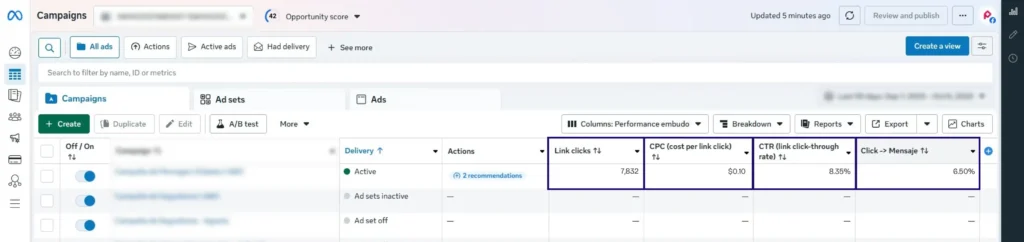
⚠️But if you still don’t have it, don’t worry, because you can place ranges above average values of the industry and estimate the results of the budget for your campaigns. If you need an audit of your social media networks, we offer a service for digital advertising to manage or audit your campaigns.
Key metrics:
CPM Cost per Thousand Reach
The CPM is typically calculated based on impressions, not reach. However, on platforms such as Meta Ads and other advertising ecosystems, such as TikTok Ads or LinkedIn Ads, in certain cases, it is calculated based on the number of clicks. Ads or LinkedIn In certain cases, it is more strategic to use cost per reach instead of the cost per impression.
The reason is simple: depending on the objective of the campaign, the volume of impressions can scale from impressions can scale in a significant way due to the frequency, which distorts the reading of the actual value generated. The impressions show how many times an ad was served, but do not reflect in accurately reflect how many unique users were impacted.
The scope, on the other hand, allows us to understand with greater precision how many people we are actually reaching and evaluate what the real cost is per impact on new accounts. This offers a reading more aligned with the final value delivered to the business, especially in campaigns where the efficiency per user achieved is a KPI critical
CTR (Click-Through Rate)
CTR is the percentage of people who click on your ad after seeing it. This metric helps you calculate how many clicks you can expect to get based on the number of impressions your campaign generates. For example, if your historical CTR is 2%, it means that out of every 100 people who see your ad, 2 will click on it. This data is essential for estimating the traffic that will reach your website or landing page.
Rate of conversion Click→Lead
This metric indicates what percentage of the people who click on your ad become leads (qualified contacts). Not all clicks generate prospects, so knowing this rate allows you to calculate how many potential leads you will obtain how many potential leads you will get from your investment in advertising. If your conversion rate from click to lead is 10%, it means that out of every 10 visitors who arrive at your page, one will leave their details. page, one will leave their contact details.
Rate of closing Lead→Sale
This is the rate that measures how many of your leads are converted ultimately into customers who make a purchase. It is crucial to understand how many actual sales you can expect from the prospects generated. The leads generated. For example, if your closing rate is 20%, of every 5 leads that you obtain, 1 will become a customer.
Revenue per sale (AOV – Average Order Value)
As mentioned above, AOV is the average amount a customer spends on each transaction. In advanced budgeting, this data is combined with other metrics to calculate the expected return on investment more accurately.
How can you use these metrics to measure the performance of your advertising campaigns? Budget for advertising campaigns?
With these four metrics, you can build a complete conversion funnel and project results in a precise manner:
Example practical
Let’s assume that you have the following historical data
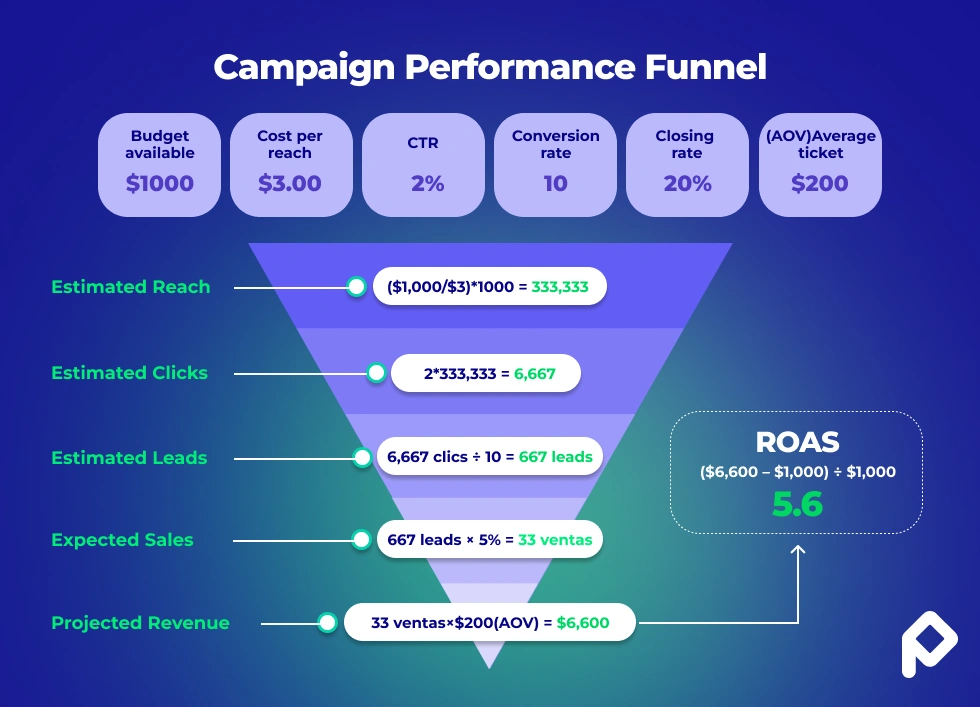
This level of analysis allows you not only to justify your budget but also to identify where in the funnel you can optimize to improve results. If your Click→Lead conversion rate is low, you may need to improve your landing page. If your closing rate is low, you may need to optimize your sales process.
Final recommendations
Update these metrics constantly based on the actual results of your campaigns.
-Conduct A/B testing to improve each stage of the funnel
-Consider seasonal variations in your projections.
-Leave a margin of error of 10-15% in your initial estimates.
-Monitor and adjust your budget weekly during the first campaigns.
With this data-driven approach, your advertising campaign budget becomes a powerful predictive tool that allows you to make informed decisions, scale what works, and correct what isn’t delivering results.
If you need help with the strategic management of your campaigns, we invite you to learn more about our digital advertising service.